The Best AI Website Builder for Small Business? Wrong Question.
Comparing Wix, Squarespace, Shopify, and WordPress? See why small businesses are moving from DIY website builders to ArboWeb's fully managed, SEO-optimized web systems.
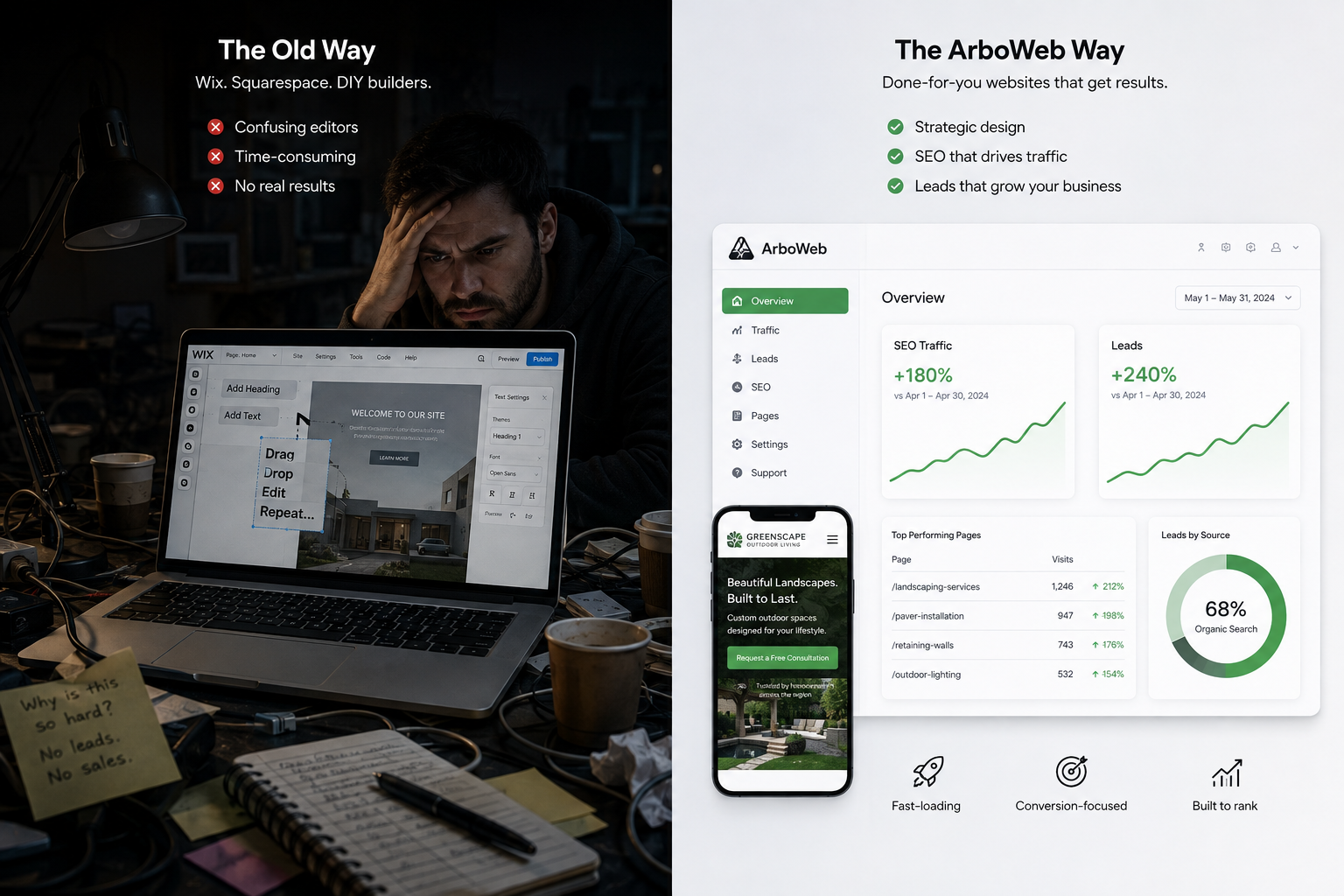
Best Website Builder for Small Business? (Why Custom Outperforms DIY)
If you're comparing website builders for your small business right now, you probably already have a shortlist: Squarespace, Wix, Shopify, maybe WordPress with an AI plugin bolted on. Each one promises the same thing — a professional-looking site in a weekend, no developer required, no code, no waiting.
And here's the thing: they're not lying. That part is true now in a way it simply wasn't five years ago.
We're living through a moment where launching a business has never been easier. Type a description of what you sell, answer a few prompts about your brand, and an AI website builder will hand you pages, a color palette, even placeholder copy, in under an hour. Basic literacy and a credit card are functionally the only barriers to entry left. That's a genuinely good thing — it's democratized a step that used to cost thousands of dollars and weeks of back-and-forth with a developer.
But it's also created a new, quieter problem. One that doesn't show up until a few weeks after launch, when the excitement of "I built a website" wears off and someone checks their analytics for the first time.
The part no builder mentions in the demo
A website builder can generate you a homepage. It cannot generate you an audience.
This is the gap almost nobody talks about when they're comparing Squarespace to Wix to Shopify: all four of them are optimized to get you to publish, not to get anyone to find what you published. The moment your site goes live, it joins millions of others built the exact same week, by the exact same tools, often using strikingly similar AI-generated copy and layouts. Search engines have gotten very good at noticing that.
So let's actually compare these platforms — not on how easy they are to launch, but on what happens to your site six months in.
Squarespace
Strength: Still the best-looking output out of the box. Its AI design assistant produces genuinely polished, portfolio-grade sites fast, which makes it a strong pick for service businesses, photographers, consultants — anyone where first impression matters more than product catalog depth.Weakness: Squarespace's SEO controls are improving but remain fairly locked down compared to open platforms. You get clean code you can't fully touch, and limited flexibility on technical SEO elements like schema markup, crawl structure, or site speed optimization once you're past the basics.
Wix
Strength: The most generous AI onboarding flow of the group — Wix ADI can build a surprisingly complete multi-page site from a short business description, and its app marketplace is enormous.Weakness: Historically Wix has carried a reputation for bloated code output, which drags down page speed — a direct ranking factor. It's improved, but small business owners often don't know to check for it, and the AI-built version rarely gets audited afterward.
Shopify
Strength: If you're selling physical or digital products, nothing else on this list matches its checkout, inventory, and payment infrastructure. Its AI tools (Sidekick, Shopify Magic) are genuinely useful for product descriptions at scale.Weakness: Shopify is built for conversion, not content. Its blog and content architecture are secondary features, which hurts you long-term because content is one of the few durable ways small businesses earn organic search traffic without paying for every click.
WordPress (with AI page builders)
Strength: Total control. Every technical SEO lever — schema, crawl budget, canonical tags, structured data, page speed — is accessible if you know where to look. No platform in this list can match its ceiling.Weakness: That ceiling is also the trap. WordPress AI builders will happily generate you a site that looks finished while quietly leaving that entire technical layer misconfigured or untouched. Most small business owners don't know what a canonical tag is, and the AI didn't ask them.
The real comparison
Notice the pattern: every platform's weakness is the same weakness, wearing a different outfit. None of them solve for what happens after deployment. They're launch tools. Discoverability was never the product.
This is exactly the gap between "I have a website" and "I have a business that people can find." An AI builder gets you to the first milestone in an afternoon. Getting to the second one is a different discipline entirely — it's technical SEO, it's site architecture, it's understanding how search engines actually crawl and rank the page your AI tool just generated for you.
Ratings reflect typical out-of-the-box performance for a small business owner without dedicated design, dev, or SEO staff. Individual results vary by template, plugins, and configuration.
What DIY Builders Actually Do Well
To be fair to Squarespace, Wix, Shopify, and WordPress — they've earned their popularity:
- Fast to start. You can have a live page in an afternoon.
- No coding required. Drag-and-drop editors are genuinely accessible.
- Low upfront cost. Monthly plans are cheap compared to hiring an agency.
- Huge ecosystems. Templates, plugins, and integrations for almost anything.
If you want a simple online presence and have the time to learn the platform, any of these can work. The issues show up later — usually around month two or three, when the site is live but the phone still isn't ringing.
The Hidden Gap: What DIY Builders Don't Do For You
This is the part most "best website builder" listicles skip, because they're written to sell you on signing up for a builder — not to tell you what happens after.
1. Templates rarely rank without custom SEO architecture
Drag-and-drop builders are optimized for design flexibility, not search visibility. Getting a template to actually rank for local, high-intent searches usually requires manual work on site structure, internal linking, schema markup, and content strategy — work the builder doesn't do for you by default.
2. Page speed and Core Web Vitals often suffer
Heavy visual builders load a lot of framework code before your content even appears. On mobile, that translates to slower load times — and Google factors page experience into rankings. Bloated themes and unused plugins compound this on WordPress especially.
3. You still have to do the strategy work yourself
A builder gives you a blank canvas. It doesn't write your copy, structure your conversion funnel, set up analytics and call tracking, or figure out which keywords your customers are actually searching. That's a separate skill set — and typically a separate 40+ hour project.
Squarespace vs. Wix vs. Shopify vs. WordPress: Where Each One Falls Short
Squarespace vs. custom website for small business: Squarespace templates look polished immediately, but customizing SEO settings (meta tags, structured data, page speed) requires digging into settings most business owners never touch.
Why is my Wix site not ranking on Google? Usually a combination of thin content, missing schema markup, and slow load times on image-heavy pages — none of which Wix's editor flags for you.
Shopify is genuinely strong for product pages, but its blog/content tools are limited, making it harder to rank for the informational searches that bring in new customers before they're ready to buy.
WordPress can outperform every option above — if someone configures hosting, caching, security, and an SEO plugin correctly. Left on default settings, it underperforms just like the rest.
Is a Website Builder Enough for Local SEO?
Short answer: usually not on its own. Ranking for local searches ("[service] near me," "[service] in [city]") depends on factors most builders don't handle automatically — Google Business Profile alignment, local schema markup, location-specific landing pages, and consistent NAP (name/address/phone) data across the web. A builder gives you the site; local SEO is a separate, ongoing discipline layered on top.
The Alternative: A Done-For-You Growth System
This is where ArboWeb fits in. Instead of handing you a template and a login, ArboWeb builds and manages a custom site engineered around SEO, page speed, and conversion from day one — for a comparable investment to what many small businesses already spend cobbling together a DIY site, a page speed plugin, an SEO tool, and freelance copywriting.
What that includes:
- Custom-built site (not a locked-in template) with SEO architecture from the start
- Copywriting and page structure built around how customers actually search
- Core Web Vitals and mobile speed optimized by default
- Analytics and lead tracking set up correctly the first time
- Ongoing management — no plugin updates, backups, or troubleshooting on you
In short: why spend 40+ hours building something yourself when you can get a custom, SEO-optimized growth engine built for you?
Ready to see what a custom-built, SEO-optimized site looks like for your business? Book a free consultation or view pricing.